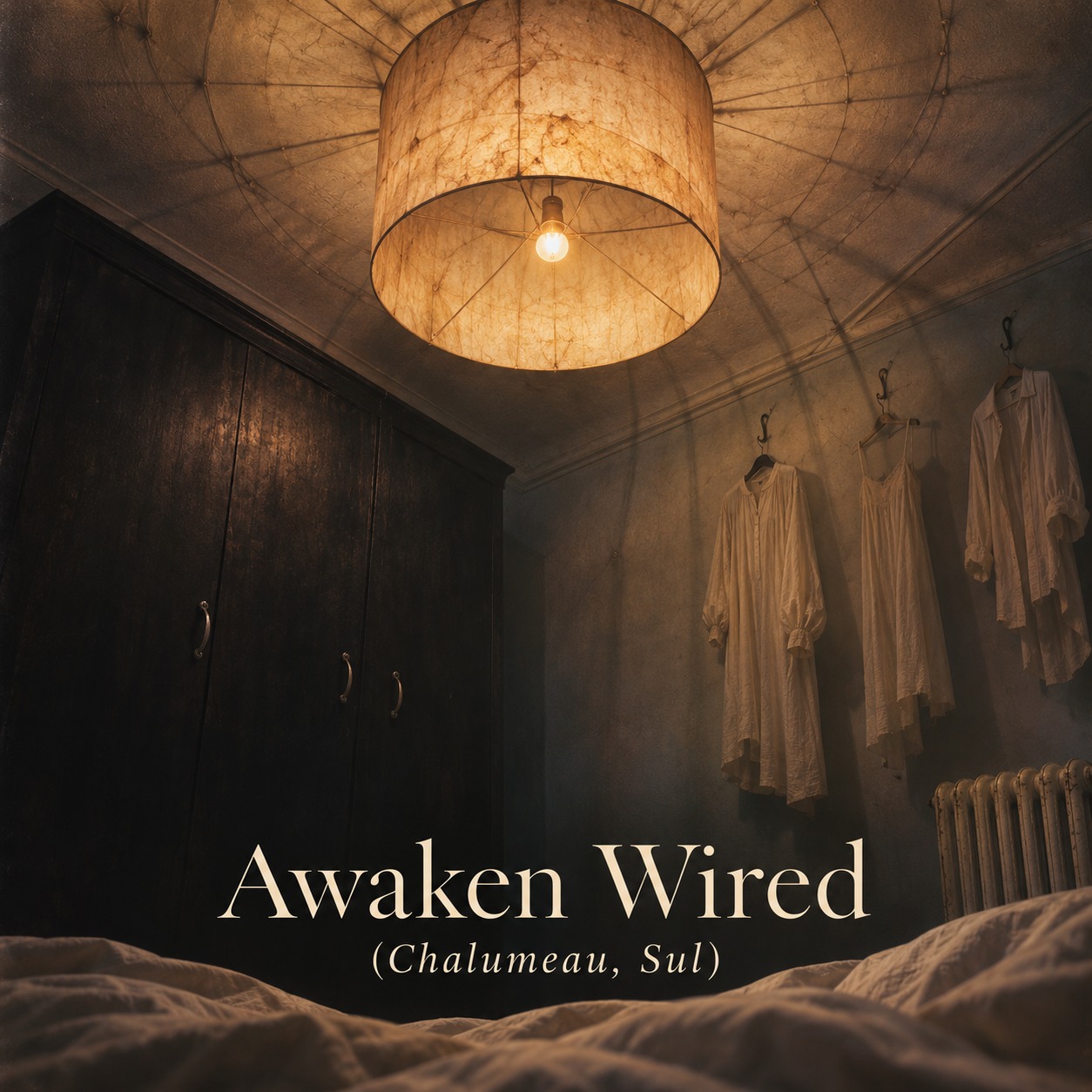
Awaken Wired (Chalumeau, Sul)
The player connects to Suno only when you choose to load it.
By Fredrik Brattén · Artist name: Ragnar Bratten
Explore the instrumental writing, layers and dramatic shape of the introduction, then read the complete composition notebook.
36 bars, 7/8 time and five phases from a barely audible room to a chamber-orchestra crescendo.
The player connects to Suno only when you choose to load it.
Artist name: Ragnar Bratten
An introduction composed as a sequence of changing states: the room breathes, a mechanical pulse takes hold, a light clicks on, and a chamber ensemble gathers until it is cut away.
Fredrik’s supplied instructions connect everyday sounds to a tightly specified musical form. Cloth, breath, wire hangers and radiator ticks become part of the written arrangement alongside prepared guitar, harmonium, bass clarinet, flute and strings.
The written plan: 116 BPM, 7/8 grouped 2+2+3.
| Bars / Phase | Dramatic movement | What the instructions ask for |
|---|---|---|
| 1–4 / 1A | The room becomes audible | Granular fabric and breath textures, small metal sounds and a very quiet, dry, widely separated stereo space. |
| 5–12 / 1B | A rhythmic motor takes hold | Prepared acoustic guitar repeats D–A–E–A–C–A–G. Radiator ticks supply metric accents while the fabric layer continues. |
| 13–20 / 2A | A switch triggers a new foundation | A central lamp-switch click cues a D/A harmonium drone and electrical hum. Bass clarinet enters in the chalumeau register. |
| 21–28 / 2B | The chamber texture tightens | Viola and cello use sul ponticello tremolos, harmonics and col legno gestures. Alto flute adds interlocking fragments above the continuing drone. |
| 29–36 / 3 | Pressure, saturation, then absence | A chamber-orchestra crescendo adds chromatic tension and microtonal glissandi. The written hard cut removes the ensemble, exposing the underlying room layers. |
The granular fabric-and-breath texture, the prepared-guitar motor with radiator accents, and the harmonium/hum foundation are introduced separately. They are asked to persist through the larger ensemble and remain when it drops away.
Chalumeau register, sul ponticello, col legno and portamento give the instructions a specific palette. These choices connect the desired physical sensation to an instrumental action.
The climax is planned together with its disappearance. Returning to the bare room makes the small, early textures part of the ending of the introduction.
This is the complete five-phase example supplied by Fredrik. Wording, notation and original spellings are retained.
[Intro - Phase 1A: Subterranean Room Tone & Foley Architecture (Bars 1-4)]
[style: electroacoustic minimalism, musique concrète, subterranean foley art, dark ambient]
[genre: experimental sound-art, avant-folk, electroacoustic chamber music]
[tempo: 116 BPM, rigid mechanical clockwork pulse, strict 7/8 time signature subdivided 2+2+3]
[mix: hyper-intimate close-mic recording, zero reverb, bone-dry acoustic space, extreme binaural left-right separation, high transient definition]
[layer 3 initialization: introduce continuous stereo granular texture; microscopic recordings of heavy cotton bedsheets twisting, dry linen shirts brushing against plaster wall, and metal wire coat hangers softly clinking; pitch-shift and time-stretch breathless vocal exhalations into a shimmering ghost-pad locked to high A4 (440Hz) and E5 (659.25Hz), panning asymmetrically in a slow figure-eight across the stereo field]
[dynamics: pianissimo possibile (ppp), tense nocturnal stillness, sensory deprivation atmosphere]
[vocals: none, strictly instrumental and electroacoustic foley]

[Intro - Phase 1B: The Thermal Pulse & Prepared Pluck (Bars 5-12)]
[style: polyrhythmic minimalism, prepared acoustic chamber-folk, mechanical rhythm-art]
[genre: avant-folk, post-minimalism, experimental acoustic]
[tempo: 116 BPM, locked 7/8 meter (1-2, 1-2, 1-2-3)]
[layer 2 initialization: introduce continuous rhythmic motor; a vintage small-body acoustic guitar prepared with a strip of dense felt and rubber wedged under the strings at the saddle; execute a relentless, dry, woody eighth-note arpeggio pattern across every bar: D3 - A3 - E4 - A3 - C4 - A3 - G3]
[percussion integration: layer a sampled cast-iron water radiator expanding under thermal pressure; sharp, resonant metallic pipe ticks locked with surgical precision to beat 1 and beat 5 of every 7/8 measure, acting as a skeletal snare and kick replacement]
[mix: prepared guitar panned 15% left with boosted 1.2kHz fingernail attack; radiator ticks panned 15% right with resonant metallic ring at 3.5kHz; layer 3 fabric whispers continuing uninterrupted in the wide periphery]
[dynamics: pianissimo (pp) to mezzo-piano (mp), hypnotic, insistent, inescapable insomnia groove]

[Intro - Phase 2A: The Incandescent Ignition (Bars 13-20)]
[style: drone minimalism, dark chamber-folk, electro-organic art-pop]
[genre: contemporary classical drone, experimental chamber music, avant-garde folk]
[sfx: at Bar 13 Beat 1, execute a loud, startling, hyper-realistic mechanical bakelite ceiling-lamp pull-cord SWITCH CLICK dead-center in the mix]
[layer 1 initialization: triggered immediately by the switch click, unleash the third continuous foundation layer; a 19th-century wooden reed harmonium fused with a raw 50Hz European electrical alternating-current ballast hum and warm vacuum-tube saturation; hold an unbroken, monolithic open fifth drone on low D2 (73.42Hz) and A2 (110Hz); emphasize the physical mechanical wheezing of the foot-pumped bellows and wooden key-thumps]
[harmony: static D5 pedal foundation supporting shifting modal clusters above: Dm9 (Bars 13-14) | Em7/D (Bars 15-16) | Fmaj7#11/D (Bars 17-18) | C6/D (Bars 19-20)]
[instrumentation: a solo bass clarinet enters in its lowest, woody chalumeau register, playing long, mournful, breathy sustained tones that rub against the harmonium drone in minor-second intervals before resolving to the ninth (E) and eleventh (G)]
[mix: harmonium and 50Hz electrical hum anchored dead-center from 40Hz to 800Hz; layers 1, 2, and 3 now fully interlocked as the permanent sonic spine of the piece]

[Intro - Phase 2B: Nocturnal Chamber Weaving (Bars 21-28)]
[style: polyphonic chamber-folk, cinematic art-pop, microtonal chamber music]
[genre: modern classical, chamber-pop, orchestral avant-folk]
[harmony: Dm9 (2 bars) | Em7/D (2 bars) | Fmaj7#11/D (2 bars) | C6/D (2 bars) over relentless D2/A2 drone]
[instrumentation: solo muted viola and solo cello enter with restless, glassy sul ponticello (bowed near the bridge) tremolos and fragile harmonics; an alto flute weaves contrapuntal, dizzying 7/8 melodic fragments that interlock mathematically with the D-A-E-A-C-A-G prepared guitar pluck]
[articulation: alternate between icy col legno (tapping strings with the wood of the bow) synced to the radiator clicks, and searing, expressive portamento slides mimicking the disorientation of staring into an unshielded lightbulb in a dark bedroom]
[dynamics: steady poco a poco crescendo from mezzo-piano (mp) to forte (f), narrowing the perceived walls of the room]

[Intro - Phase 3: The Blinding Filament Crescendo & Hard Cut (Bars 29-36)]
[style: maximalist avant-pop, dissonant orchestral chamber-rock, spectralism]
[genre: experimental orchestral art-pop, avant-garde classical, noise-chamber]
[tempo: 116 BPM, frantic 7/8 urgency, zero rubato]
[harmony: relentless chromatic upward tension climb over immovable D pedal: Bbmaj7/D (Bars 29-30) | Gm9/D (Bars 31-32) | A7(b9)/D (Bars 33-34) | A7#5#9/D (Bars 35-36)]
[instrumentation: full 12-piece chamber orchestra erupts; first and second violins, violas, cellos, double bass, oboe, English horn, bass clarinet, and contrabassoon engage in a staggered upward microtonal glissando, climbing slowly across two octaves toward a piercing, blinding high-register cluster]
[percussion: radiator metallic clicks double into sixteenth-note chatter; deep orchestral floor toms, dry wooden rimshots, and brushedconcert bass drum pound out the 2+2+3 metric accents with brutal physical weight]
[mix: push the entire chamber orchestra into warm analog tape saturation and heavy bus compression; high-frequency string overtones shimmer blindingly between 6kHz and 12kHz like an overheated tungsten filament about to snap; keep the 3 core room layers buried but audible inside the maelstrom]
[dynamics: climb relentlessly to an overwhelming, claustrophobic fortissimo possibile (fff) at Bar 36 Beat 6]
[transition: at Bar 36 Beat 7, execute an instantaneous, surgical RAZOR-SHARP HARD CUT of the entire chamber orchestra, woodwinds, bass, and percussion; zero reverb tail on the orchestra; leave a startling 1-beat vacuum where ONLY the bare, naked 3 continuous room layers (50Hz harmonium drone, muted guitar pluck, radiator click, and fabric breath) remain suspended in bone-dry air]
Music, moving images and the decisions behind them.
Explore the collection →